Abonotich—a forgotten ancient port of Paphlagonia on the Black Sea coast
On the gentle slope where the Black Sea town of İnebolu bustles today, Abonotich once stood—a small Greek emporium that became famous throughout the ancient world thanks to one of the most scandalous religious scams in history. It was here, in Abonotich, in the 2nd century CE, that the cult of the serpent god Glycon and his inventive prophet Alexander emerged—a figure satirized with biting irony by the writer Lucian of Samosata. Today, neither walls nor columns remain of the ancient city, but its name lives on in the Turkish name İnebolu and on rare bronze coins bearing the inscription ΑΒΩΝΟΤΕΙΧΙΤΩΝ. This is a place for the explorer-traveler, the lover of religious history, and those undeterred by the long kilometers along the winding Black Sea road in search of the spirit of vanished cities.
History and Origins of Abonotich
According to the most widely accepted version, the city was founded around the 3rd century BCE as an emporium—a trading post dependent on the powerful Sinope, the largest Greek polis in the southern Black Sea region. The very name of the city speaks to its origins: Ἀβώνου τεῖχος, translated from Ancient Greek, means “the wall of Abonos” or “the fortress of Abonos,” where Abonos is apparently the name of the original owner or founder of the fortification. The inhabitants called themselves Αβωνοτειχίτης—“Abonotichites.”
The location was chosen wisely. The Paphlagonian coast between Sinope and the mouth of the Galis River (modern-day Kyzylirmak) was a mountainous, impassable territory with a narrow strip of fertile land by the sea. Abonochis became one of the few convenient harbors in this stretch, a transshipment point for the trade in timber, resin, flax, and slaves, which flowed through Sinope to the Mediterranean. The city’s strategic importance was modest but sufficient for it to endure through centuries of upheaval.
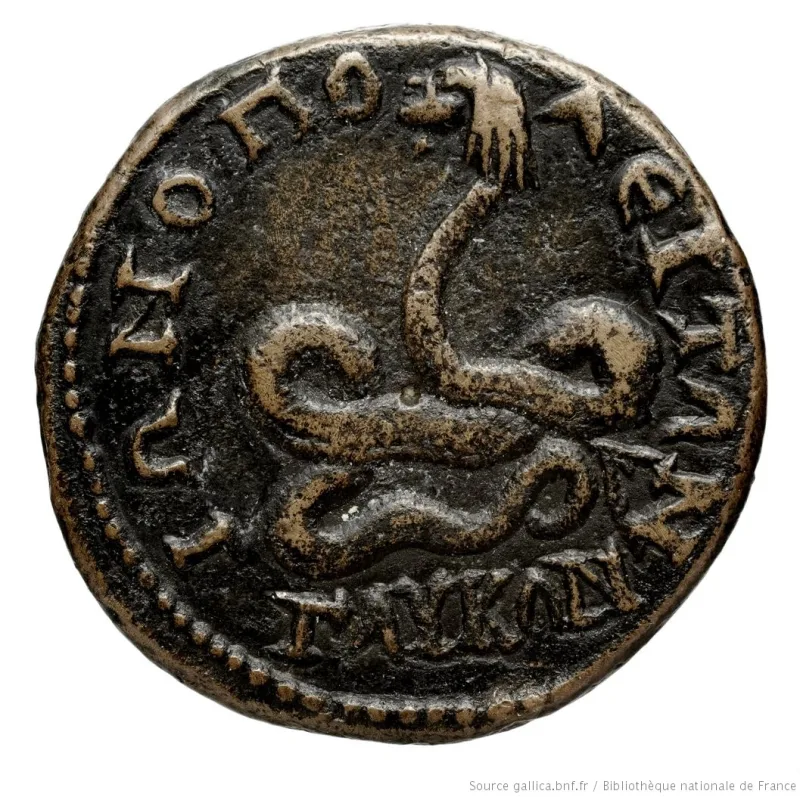
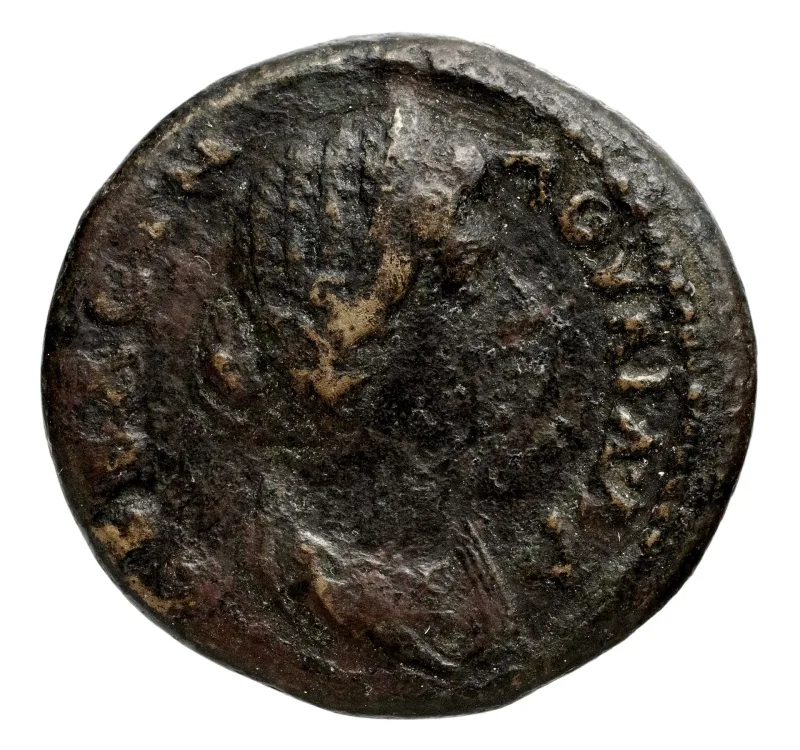
In 64 BCE, following the Third Mithridatic War, the region came under Roman influence. Paphlagonia became part of Rome’s provincial system, and Abonotich, like most of the small Greek coastal cities, retained its autonomy in exchange for loyalty. The city’s bronze coins, minted during the reigns of the emperors Antoninus Pius, Marcus Aurelius, Lucius Verus, and Lucilla, attest to a stable, albeit modest, municipal life.
It was in the 2nd century CE that an event occurred that changed the city’s fate. Alexander, a local native—a charismatic and enterprising man, a disciple of the followers of the famous miracle-worker Apollonius of Tyana—founded a new cult here dedicated to the serpent god Glycon. According to Lucian, Alexander appealed to the Roman emperor (presumably Antoninus Pius) with a request to rename his hometown from Abonotich to Ionopolis—“the city of Ion,” the brother of Asclepius. It is unknown whether the emperor officially granted this favor, but the inscription ΙΩΝΟΠΟΛΙΤΩΝ does indeed appear on later coins, and by the Byzantine era, the city was known only as Ionopolis. It is from this name, through centuries of distortion, that the modern Turkish name İnebolu originated.
Architecture and What to See
Let’s start with an honest admission: there are practically no archaeological ruins of Abonotich as such. Neither walls, nor temples, nor the agora have survived, and no systematic excavations have been conducted in the territory of modern İnebolu. The ancient layer lies beneath the modern city, partly eroded by the sea and partly built over. Nevertheless, there is plenty for travelers to see here—you just need to shift your perspective from “inspecting ruins” to “reading the landscape.”
The shore, the harbor, and the contours of the ancient city
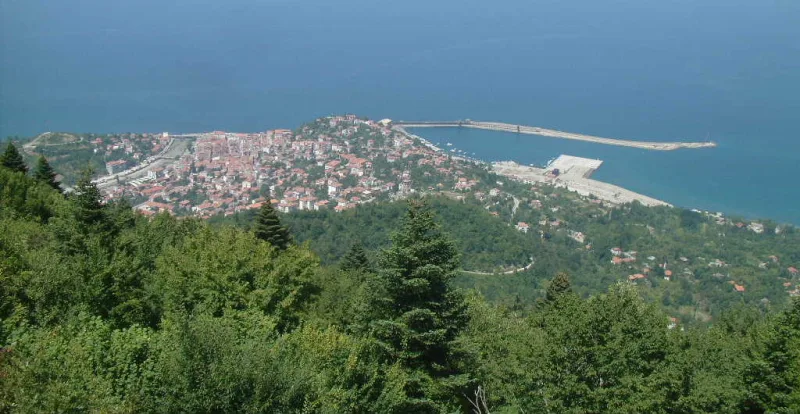
A walk along the Inebolu waterfront gives a wonderful sense of why this particular spot was chosen by the Greek colonists. From the east and west, the bay is sheltered by low headlands; to the north lies the open sea; and to the south, an amphitheater of hills. The ancient port was located roughly where the modern pier stands; it was here that ships carrying Black Sea goods to Sinope, and from there to Aegea, would moor. From the nearest hill, a panorama unfolds that has remained virtually unchanged for two thousand years.
The site where the Temple of Apollo once stood
According to ancient sources, a temple of Apollo stood in Abonoti in the 2nd century CE—it was there, according to Lucian’s account, that Alexander staged the miraculous birth of the god Glycon by placing a small live snake inside a hollowed-out goose egg. The exact location of the temple cannot be determined today, but it most likely stood in the central part of the ancient city—roughly where the old Inebolu quarter is now, with its Ottoman mosque and traditional wooden houses.
Coins, Inscriptions, and Numismatic Traces
The main material trace of Abonoteich is its coins. Bronze coins bearing the legends ΑΒΩΝΟΤΕΙΧΙΤΩΝ and ΙΩΝΟΠΟΛΙΤΩΝ were minted in the 2nd century, featuring portraits of emperors and their female relatives, including Lucilla, the wife of Lucius Verus. Some coins depict the serpent Glycon with human ears—exactly as Lucian described it. These coins are housed in the world’s largest museum collections; in Turkey itself, individual examples can be seen at the Kastamonu Archaeological Museum and the Istanbul Archaeological Museum.
The Pantheon of the Ancient City
In addition to Apollo and Glycon, Zeus, Asclepius, Dionysus, Nike, Artemis, and Zephyr were worshipped in Abonoti—a typical set of city cults for an ancient Greek city. This points to a vibrant religious life, complete with festivals, processions, and sacrifices, of which not a single stele remains today.
The Legacy of Iopoliss: A Christian Legacy
In late antiquity, the city became a bishopric within the Metropolis of Gangra (modern-day Çankırı). The French historian Michel Lecien, in his work *Oriens Christianus*, mentions eight bishops of Iopol between 325 and 878—from Petronius, who participated in the Council of Nicaea in 325, to Nikitas, who in the 11th century served simultaneously as bishop and chartoularios of the Great Orphanotrophion of Constantinople. Bishop Ren attended the Council of Chalcedon in 451, and Diogenes attended the Council of Ephesus in 431. A separate bishop named John is mentioned in the 11th century. After the 11th century, the episcopal see gradually declined following the general decline of Byzantine influence in the region, and in the 20th century, the title of Iopoliss was nominally revived by the Roman Catholic Church as a titular bishopric (from 1929 to 1971), held, among others, by the American Cardinal of Baltimore, James Gibbons—one of the most influential Catholic hierarchs in the United States at the turn of the 19th and 20th centuries.
The landscape and atmosphere of modern Inebolu
On a summer evening, the modern town resembles the setting of a provincial novel: wooden Ottoman houses descend in terraces toward the sea, fishermen mend their nets by the pier, and the scent of grilled anchovies and freshly baked pide wafts over the rooftops. It is this unhurried rhythm, rather than the majestic ruins, that becomes the main impression of a visit to Abonotich—as if the town had deliberately hidden its ancient past beneath a layer of everyday Black Sea life.
Interesting Facts and Legends of Abonotich
- Lucian of Samosata, in his pamphlet “Alexander, or the False Prophet,” describes how the founder of the cult of Glycon in Abonotich used a hand-held snake from Macedonia with a human-shaped fabric mask attached to it; mechanical jaws were controlled by hidden strings, and the “god” supposedly spoke to the pilgrims.
- According to Lucian, Alexander was so successful that Emperor Marcus Aurelius himself and the generals marching to the Parthian War sent him inquiries. One of Glycon’s “oracles”—the recommendation to throw two lions into the Danube—allegedly resulted in a military disaster for the Roman army.
- The name Ionopolis, which the city received at Alexander’s request, is associated with Ion—the mythological brother of Asclepius—or, according to another version, with the Ionian Greeks who colonized the coast. This renaming is a rare instance where a religious scandal altered place names for millennia.
- The modern Turkish name İnebolu is a direct corruption of the Greek Ἰωνόπολις: through the stages Aineboli, Ineboli, and Ainepoli, the word gradually took on its current form. Sometimes in medieval sources, the city was simply called Abono.
- The cult of Glycon has had a remarkable influence on modern culture: a Romanian sculptor of Czech origin and the city of Constanța itself preserve a 2nd-century marble statue of Glycon, discovered in 1962—the only surviving full-length depiction of the “serpent god.”
How to get to Abono
Modern İnebolu is located in the province of Kastamonu, on the northern coast of Turkey, approximately 100 km north of the provincial capital Kastamonu and 200 km east of Sinop. For travelers from Russia, the most convenient option is to fly to Istanbul (IST or SAW airports) and then take a domestic flight to Kastamonu (Kastamonu Airport, code KFS)—the flight takes about 1 hour and 15 minutes. There are also regular flights to Samsun (SZF Airport), from where it is about 260 km to İnebolu along the scenic coastal road D010.
You can get from Kastamonu to İnebolu by dolmuş or intercity bus in about 2 hours; the road winds through mountain passes and offers a wonderful view of the Paphlagonian landscape. Direct buses run from Istanbul at night, taking 11–12 hours. By car from Istanbul, it’s about 750 km; it’s more convenient to split the trip into two parts with an overnight stay in Kastamonu or Safranbolu. Public transportation within İnebolu is practically unnecessary: all points of interest are within walking distance.
Tips for travelers
The best time to visit is late spring (May–June) and early fall (September–October). In summer, the coast is hot and humid, while in winter, the Black Sea off İnebolu is gray and stormy, with strong winds and frequent rain. Snow is rare here, but temperatures in January drop to 2–5 degrees Celsius. In the off-season, the soft light makes the ancient contours of the coastal hills particularly striking, and crowds of tourists in this corner of Turkey are minimal to begin with.
What to bring: comfortable shoes for walking along the promenade and up the hills, a camera, Lucian’s book *Alexander, or The False Prophet* (the Russian translation is available in the “Literary Monuments” series)—reading it right where the action took place is a special treat. Get some cash in Turkish lira beforehand: there are ATMs in İnebolu, but not many. English isn’t widely understood here, so a basic phrasebook or a translation app on your phone will come in handy.
What to combine your trip with: 90 km to the south lies Kastamonu with its Seljuk mosques, Ottoman castle, and ethnographic museums, and a 3-hour drive to the east is the famous Safranbolu with its 18th-century houses protected by UNESCO. If you have two or three days, you can put together a full-fledged “Paphlagonian Coast” itinerary: Amasra, İnebolu, and Sinop—three ports with a thousand-year history, each with its own character. In İnebolu itself, be sure to try the local fish—hamsa and barabulka, freshly caught Black Sea flounder, and Paphlagonian goat’s milk cheeses, served in family-run restaurants by the pier.
Don’t expect spectacular ruins or “ancient city here” signs in Abonotich: this is a place for those who come to read the landscape, not to compare photos from a guidebook. But it is precisely in this subdued, almost non-touristy atmosphere of the Black Sea town that Abonotich reveals itself as a rare historical phenomenon—a place where a small emporium on the edge of the civilized world gave rise to a cult debated by Roman emperors and chronicled by one of antiquity’s finest satirists.